
Happy snow day everyone! I don’t know if where you are there is snow today, but as I look out my window here at our house in East Tennessee, the ground is covered in about 4 inches.
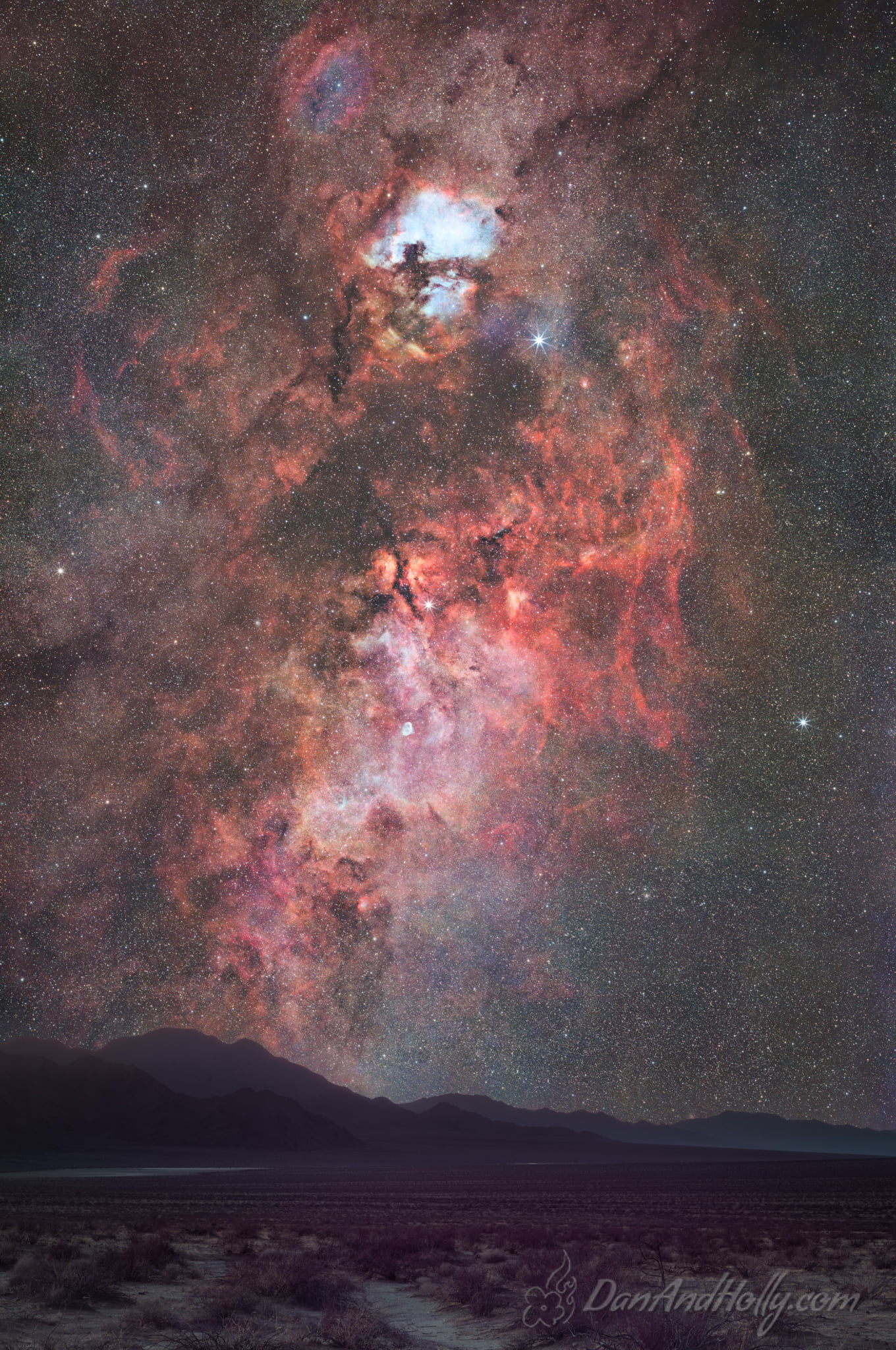
Moving on to this week’s Picture of the Week. Every time I visit Joshua Tree and the Mojave Desert, I’m struck by these mountains. As best I can tell they’re called the Bullion Mountains, but nothing seems to be labeled very well out there, and many of the peaks – again, as best I can tell – are nameless. I’ve tried to photograph them a number of times, but haven’t come back with anything I really like. When I visit in the spring, nothing in the night sky really lines up with them well, and so up until last year, I’ve just enjoyed them as I drive by. As I was planning my second trip last year, however, I noticed that in September, things get a little more interesting. Cygnus sets behind the mountains, which is definitely at the top of my list of favorite night sky objects. Having realized that, I set out to capture it all when I was there again in early fall of last year.
Some of you may recall seeing this image from my 5 Favorite Photos of 2025 post. It’s was a favorite for a number of reasons, including just loving the mountain range as I mentioned above. Beyond this, though, it represents a technical leap forward for my night images. The Cygnus area of the sky is very rich in hydrogen alpha (Ha) emission (i.e. bright reds) and is most often represented as only red in popular widefield night photography. Even my own images of it up until this point were shades of red, because that’s the only filter I had. That changed this year, however, as I added to my collection of filters a filter that sees other light sources (specifically Sii and Oiii), bringing in the yellows and blues you see featured in the image above, in addition to the bright reds. To create this, I used my older Ha-prominent filter, and then this new filter, and combined it all in post, for my most detailed shot of Cygnus yet!
Also new for this image is the filter I used on the foreground. For this image I took advantage of a new “night vision” filter, which has it’s origins in security cameras that can see in the dark thanks to infrared pass-through. The way this filter works is it passes through the light we can see with our eyes, and also passes through infrared light beyond 850nm. This is the first image I used that on that I felt really strongly about the results.
Now of course, all this new tech doesn’t mean that it will inherently be a great image. I just point all this out as pieces that excite me about the image. Ultimately it all came together for me in the final result, yielding what I think is a super impressive sky and mountains I’ve been enamored with for a long time.
More next week!
–Dan Thompson